

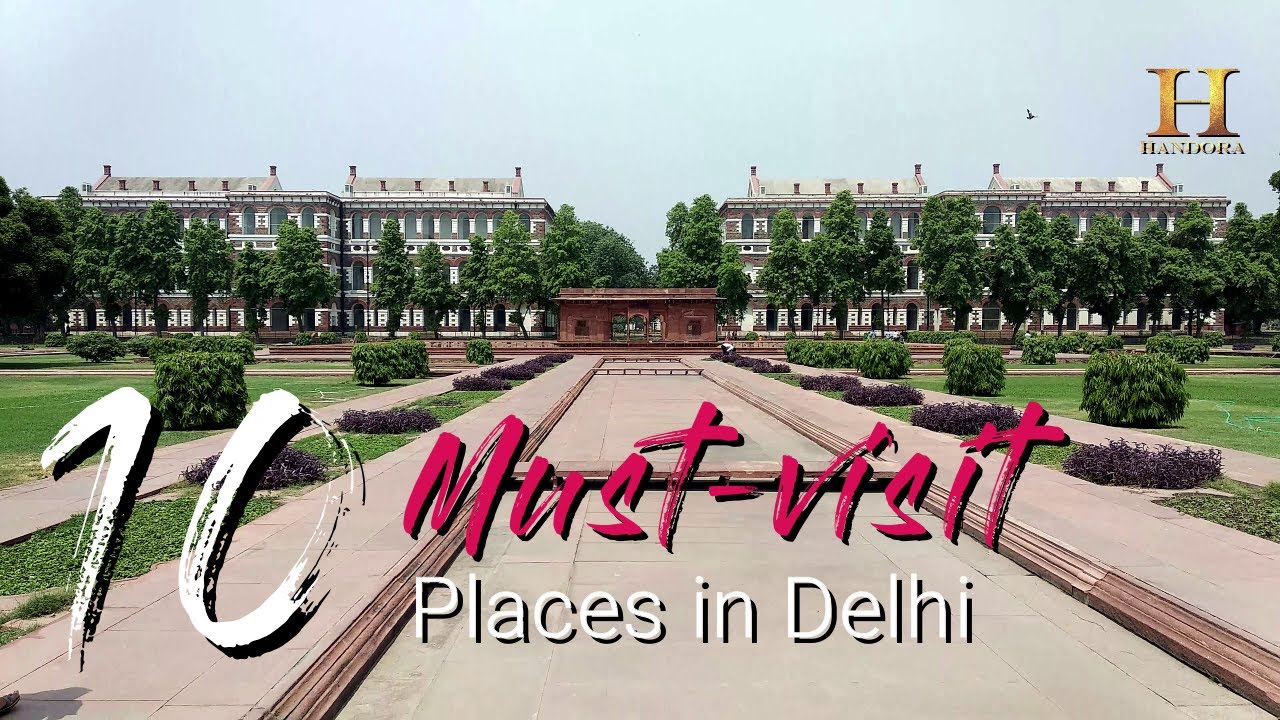
 Delhi is the capital city of India. It has been continuously inhabited since the 6th century BCE. Through most of its history, Delhi has served as a capital of various kingdoms and empires. It has been captured, ransacked and rebuilt several times, particularly during the medieval period. Modern Delhi is a cluster of a number of cities spread across the metropolitan region.
 The Qutub complex are monuments and buildings from the Delhi Sultanate situated at Mehrauli in Delhi. Many subsequent rulers, including the Tughlaqs, Alauddin Khalji and the Britishers added structures to the complex. Apart from the Qutb Minar and the Quwwat ul-Islam Mosque, other structures in the complex include the Alai Darwaza, the Alai Minar, the Great Iron pillar, the ruins of several earlier Jain temples, and the tombs of Iltutmish, Alauddin Khalji, and Imam Zamin.
Purana Quila was built between 1533 and 1538 by the Mughal emperor Humanyun. The fort originally lay on the bank of the river Yamuna before the river changed its course. The Purana Quila was built by Humayun in an attempt to build a city of his own. When Sher Shah defeated Humayun most of the structures inside the old fort were demolished and was renamed. But once again as Humayun recaptured his city from Sher Shah's son he took the task of completing the city and rebuilding its old glory. Purana Qila is also thought by some to be located at the site of the legendary city of Indraprastha founded by the Pandavas from Mahabharata period.
Emperor Shah Jahan commissioned the construction of the Red Fort on 12 May 1638, when he decided to shift his capital from Agra to Delhi. It was the main residence of the emperors of the Mughal dynasty for nearly 200 years. It was the ceremonial and political center of the Mughal state.
Humayun’s tomb was built by his widow Hamida Banu Begum, who commenced the construction of a mausoleum for her deceased husband in 1565, nine years after his death. The construction was finished in 1572. It was the first garden-tomb on the Indian subcontinent.
There are no known historical records to prove who built Agrasen ki Baoli, it is believed that it was originally built by the legendary king Agrasen, and rebuilt in the 14th century by the Agrawal community which traces its origin to Maharaja Agrasen. This Baoli, with 103 steps, is among a few of its kind in Delhi.
Jantar Mantar is located in the modern city of New Delhi. It consists of 13 architectural astronomy instruments. The site is one of five built by Maharaja Jai Singh II of Jaipur, in 1724. The primary purpose of the observatory was to compile astronomical tables and to predict the times and movements of the sun, moon, and planets.
The India Gate is a war memorial located astride the Rajpath, on the eastern edge of the "ceremonial axis" of New Delhi formerly called the Kingsway. India Gate is a memorial to 70,000 soldiers of the British Indian Army who died in the period 1914–21.
National War Memorial is built in the form of four concentric circles, each chakra signifying different values of the armed forces. Names of 25,942 war casualties have been inscribed on 16 walls of the National War Memorial. The Param Yodha Sthal has the busts of 21 recipients of the Param Vir Chakra.
The Lotus Temple, located in Delhi is a Bahá'í House of Worship that was dedicated to public worship on December 1986. It is open to all, regardless of religion or any other qualification.
Tughlaqabad Fort is a ruined fort in Delhi, built by Ghiyas-ud-din Tughlaq, the founder of Tughlaq dynasty, of the Delhi Sultanate of India in 1321. It was later abandoned in 1327.
The National Rail Museum in Chanakyapuri, New Delhi, displays exhibits on the history of rail transport in India. The museum was inaugurated on 1 February 1977. This unique museum features a collection of some 100+ real size exhibits of Indian railway.
The latest addition to Delhi's list of attractions, Waste to Wonder Park features the replicas of iconic seven wonders of the world, created from industrial and other waste. The monuments include – the Taj Mahal, Great Pyramid of Giza, Eiffel Tower, Leaning Tower of Pisa, Christ the Redeemer of Brazil, Rome’s Colosseum and the Statue of Liberty.


0 Comments